Why Battery Specifications Matter
When comparing electric pruning shears, many buyers focus only on battery capacity, usually expressed in milliamp-hours (mAh).
While capacity is important, it is only one part of the equation.
Two batteries with the same mAh rating can deliver very different performance depending on their voltage, cell configuration, and overall energy storage.
For professional users, understanding these specifications can help identify tools that provide consistent cutting power, longer runtime, and greater efficiency in the field.
mAh vs. Watt-Hours (Wh)
One of the most common misconceptions is that a higher mAh rating automatically means a longer runtime.
In reality, the total energy stored inside a battery is measured in Watt-hours (Wh).
Formula:
Voltage (V) × Capacity (Ah) = Energy (Wh)
Because voltage is included in the calculation, Watt-hours provide a much more accurate way to compare battery performance.
Consider the following examples:
| Battery | Voltage | Capacity | Energy |
|---|---|---|---|
| 18.5V × 2Ah | 18.5V | 2Ah | 37Wh |
| 18.5V × 4Ah | 18.5V | 4Ah | 74Wh |
| 21.6V × 4Ah | 21.6V | 4Ah | 86.4Wh |
Although the last two batteries are both rated at 4000mAh, the higher-voltage battery stores significantly more energy.
This is why professional users should compare batteries by Watt-hours rather than mAh alone.
Understanding Battery Pack Configurations
Lithium-ion battery packs are commonly described using terms such as 5S1P, 5S2P, and 6S1P.
These designations describe how individual battery cells are arranged inside the battery pack.
What Does "S" Mean?
"S" stands for Series.
Cells connected in series increase voltage.
Examples:
- 5S = Five cells connected in series
- 6S = Six cells connected in series
Higher voltage allows the motor to operate more efficiently under load and maintain stronger cutting performance.
What Does "P" Mean?
"P" stands for Parallel.
Cells connected in parallel increase capacity.
Examples:
- 1P = One cell per group
- 2P = Two cells per group
Increasing the number of parallel cells increases total energy storage and can extend runtime.
Prunarbo Battery Systems Explained
The Prunarbo lineup uses three battery platforms designed for different pruning workloads.
| Battery Model | Configuration | Cell Count | Nominal Voltage | Capacity | Energy |
| PR-002 | 5S1P | 5 Cells | 18.5V | 2Ah | 37Wh |
| PR-001 | 5S2P | 10 Cells | 18.5V | 4Ah | 74Wh |
| B25.2.4 | 6S1P | 6 Cells | 21.6V | 4Ah | 86.4Wh |
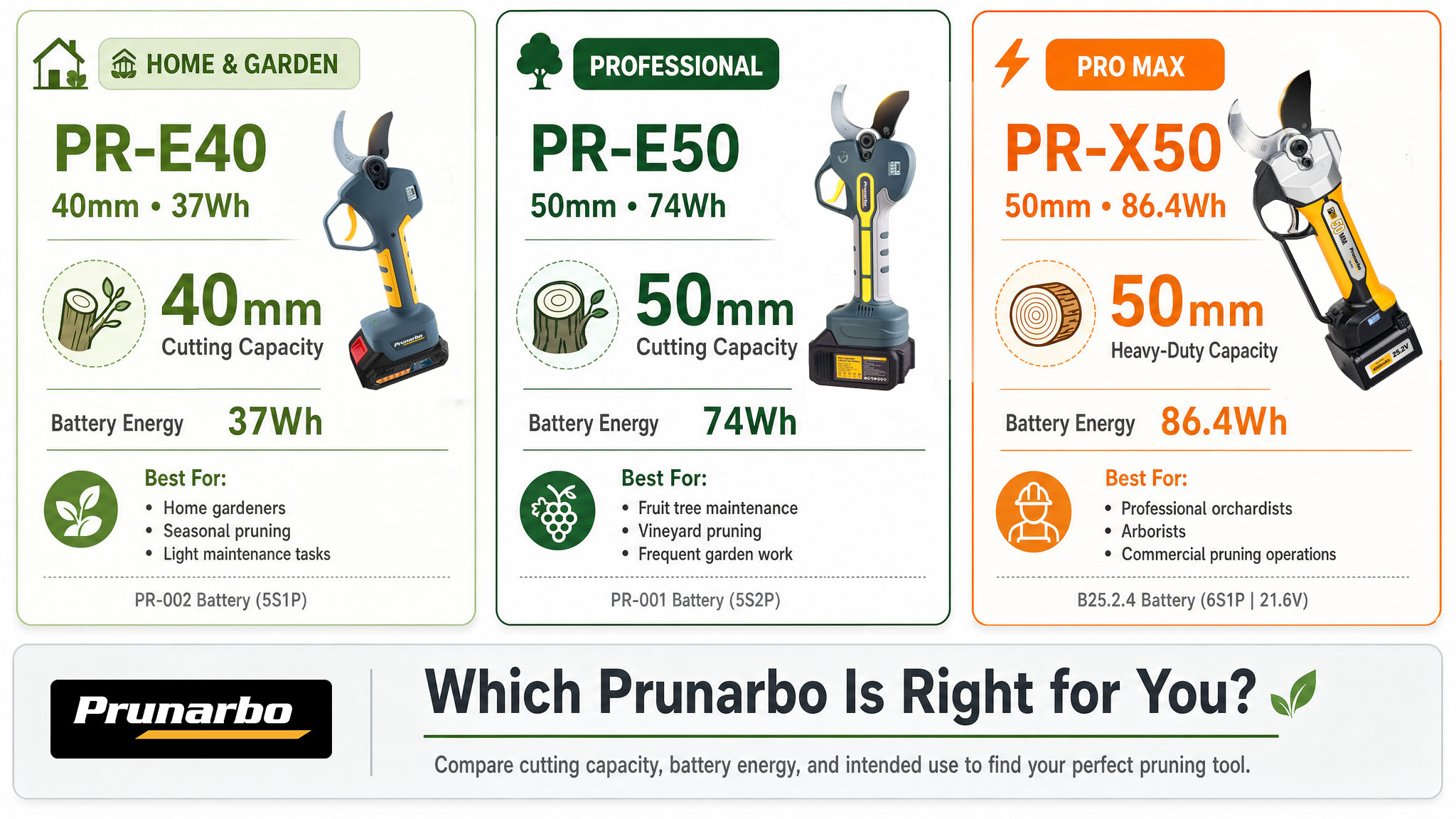
PR-002 Battery (5S1P | 37Wh)
Used in the PR-E40 pruning shear.
Designed for:
- Home gardening
- Seasonal pruning
- Light maintenance tasks
The compact 5S1P design keeps overall tool weight low while providing sufficient runtime for routine pruning applications.
PR-001 Battery (5S2P | 74Wh)
Used in both the PR-E50 pruning shear and the PR-E8 mini chainsaw.
The 5S2P configuration doubles the capacity of the PR-002 battery while maintaining the same nominal voltage.
Benefits include:
- Increased energy storage
- Longer runtime
- Improved endurance for orchard work
- Better suitability for frequent daily use
With 74Wh of stored energy, the PR-001 battery is designed for demanding pruning and cutting applications.
B25.2.4 Battery (6S1P | 86.4Wh)
Developed specifically for the PR-X50 Professional Pruning Shear.
Specifications:
- 6S1P configuration
- 21.6V nominal voltage
- 4000mAh capacity
- 86.4Wh energy storage
The higher voltage architecture allows the PR-X50's 1100W brushless motor to maintain strong cutting performance when tackling larger branches and heavy workloads.
This battery platform is intended for:
- Professional orchardists
- Arborists
- Vineyard managers
- Commercial pruning operations
Why Does the B25.2.4 Battery Store More Energy with Fewer Cells?
At first glance, it may seem surprising that the PR-001 battery contains ten cells while the B25.2.4 battery contains only six.
The explanation lies in battery architecture.
The B25.2.4 battery utilizes a 6S configuration that increases nominal voltage from 18.5V to 21.6V.
Since battery energy is calculated as:
Wh = V × Ah
the higher voltage enables the B25.2.4 battery to store 86.4Wh of energy despite using fewer individual cells.
This design helps the PR-X50 deliver higher cutting power while maintaining excellent runtime and efficiency.
Battery Performance Is More Than Just Capacity
Even the highest-capacity battery cannot achieve maximum performance without an efficient motor.
Several factors influence real-world runtime:
- Branch diameter
- Wood hardness
- Cutting frequency
- Ambient temperature
- Battery quality
- Motor efficiency
This is why all Prunarbo electric pruning tools utilize brushless motor technology.
Why Brushless Motors Improve Runtime
Compared with traditional brushed motors, brushless motors generate less friction and less heat.
This improves overall efficiency and allows more battery energy to be converted into cutting power.
| Feature | Brushed Motor | Brushless Motor |
| Energy Efficiency | Lower | Higher |
| Heat Generation | Higher | Lower |
| Maintenance | Brush Replacement Required | Minimal Maintenance |
| Runtime | Shorter | Longer |
| Service Life | Shorter | Longer |
For professional users, this often translates into more cuts per charge and more productive working hours.
The Bottom Line
When evaluating electric pruning shears, don't focus solely on mAh ratings.
A battery's real-world performance depends on a combination of:
✔ Voltage
✔ Watt-hours (Wh)
✔ Cell configuration
✔ Battery quality
✔ Motor efficiency
Understanding these specifications makes it easier to compare tools objectively and select the right system for your workload.
Whether you're maintaining a backyard garden, managing a vineyard, or operating a commercial orchard, choosing the right battery platform can make a significant difference in productivity and efficiency.
Compare the Prunarbo Battery Platforms
From the lightweight PR-E40 to the professional-grade PR-E50 and the flagship PR-X50, Prunarbo offers battery systems engineered for different pruning demands.
Explore the differences in battery architecture, cutting performance, and runtime to find the pruning tool that best matches your workload.